
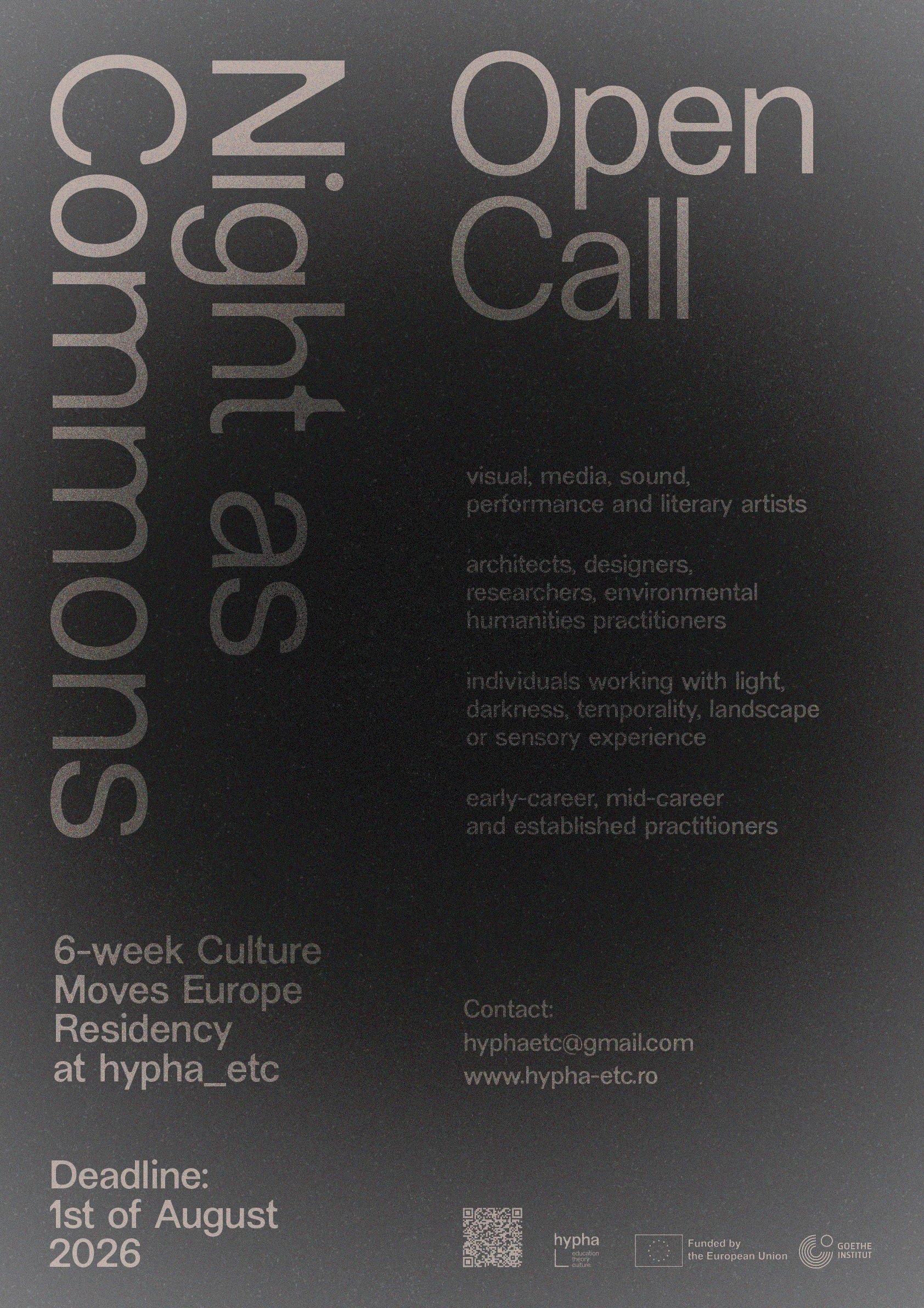
CALL FOR APPLICATIONS!
6-week residency in Vármező / Câmpu Cetății, Transylvania, Romania
Period: 1 October – 10 November 2026
Application deadline: 1 August 2026
The residency programme starts from a fundamental yet largely unacknowledged phenomenon of everyday life: photoperiodicity. This term refers to the way the Earth’s cosmic movements organize light and darkness into a rhythmic structure. This rhythm is not merely a natural backdrop but has, for centuries and millennia, shaped biological life, social organization, and cultural practices: how humans perceive time, how they work and rest, and how they exist collectively. In this context, darkness is not “lack,” but one half of terrestrial experience. As the counterpart of daylight, it delineates a different regime of perception: withdrawal, sleep, orientation, and sensory attunement. Cultural and ecological significance of darkness has become increasingly obscure because modern infrastructures present the continuous presence of light as a natural and self-evident condition.
The spread of artificial lighting was not merely a technical innovation, it fundamentally reorganized the relationship between time and human activity. In illuminated cities and workplaces, time gradually detached itself from the natural alternation of day and night and became an abstract, measurable, extendable resource, governed by the imperatives of continuous operation and productivity. From a Marxist time-critical perspective—particularly that of Moishe Postone—light functions as a technology of temporal abstraction. It sustains a social order in which life is subordinated to the self-expansion of value. In this framework, the elimination of darkness is not an accidental by-product but a structural tendency. Night-time illumination thus transforms what was once a collectively shared, non-productive temporal commons into exploitable time. The night is colonized, integrated into the regime of accumulation, and lose its capacity to suspend economic activity.
Artificial night-time illumination and skyglow have by now become a significant ecological factor. Continuous light negatively affects animal behavior, plant cycles, and the balance of ecosystems that, for millennia, synchronized their reproductive patterns, seasonal rhythms, and modes of orientation with natural photoperiodicity. From the perspective of time critique, this can be understood as the ecological manifestation of temporal colonization: capitalist time treats nature as an external and inexpensive resource rather than a living system, it remains indifferent to natural rhythms. The disruption of circadian cycles in animals, plants, and humans is therefore a structural outcome rather than an unintended consequence. Light pollution exemplifies how abstract social imperatives materialize as ecological violence: insects, birds, and entire ecosystems are forced to adapt to a temporality that did not emerge with them and does not recognize their limits. This raises a fundamental question: beyond humans, does anyone actually need artificial light?
The residency aims to open a space of reflection. It translates the artistic relevance of darkness into experiential situations through visual, spatial, and research-based practices. Through night-time photography, installations, spatial interventions, and visual articulations of darkness, the project creates situations in which participants can both experience photoperiodicity and actively interpret or contextualize it. These situations do not offer technocratic solutions. Here, art operates as a sensory and conceptual critique of political economy: it does not explain but allows participants to experience and interpret how light reorganizes space, time, attention, movement, and forms of collective presence.
What is covered:
Accommodation for 6 weeks
Travel allowance
under 5.000 km = 400 €
from 5.000 km = 800 €
Daily allowance: 30 €
Top-ups (if applicable)
OCT/OR top-up
For residents who legally reside, or have their destination, in an OCT/OR (see section ‘Which are the Creative Europe countries?’). 175 € per resident
Visa top-up
For residents who must obtain a visa to enter the destination country. 120 € per resident
Accessibility support (if applicable)
Family top-up
For residents with children under 18 years old at the time of the residency. 200 € per child, per resident
If the travel distance is less than 600 km, the residents must travel via green means of transport (any means other than airplane), unless they have a disability which prevents them from travelling differently. An exception also applies if they reside in/plan to travel to an island accessible only by airplane.
If the travel distance is 600 km or more, residents are eligible for the green mobility top-up: 400 € per resident
Research environment
· 7200 m2 yard + beech forest
· exceptionally dark skies
· 35 m2 private studio-apartments (bathroom + kitchenette, large windows, suitable as
· private studios)
· 80 m2 common workshop space
· 80 m2 communal dining area
· fully equipped community kitchen
· natural biological pond
· microscopes (stereo + biological), dedicated CMOS Camera
· telescopes (night-time + solar), binoculars, HD spectiv, dedicated CMOS Camera
· video and time-lapse cameras
· 3D scanner and printer
· sewing machine
· tools for woodworking and DIY progects
All facilities are step-free and accessible.
The residency also offers interdisciplinary mentorship from experts in physics, biology and curatorial research, supporting both scientific grounding and artistic development.
Applicants may come with a partner or family member
Eligibility — Who can apply
Applicants must be legally based in one of the Creative Europe countries, including the OCTs and ORs:
Albania, Austria, Armenia, Belgium, Bosnia-Herzegovina, Bulgaria, Croatia, Cyprus, Czech Republic, Denmark, Estonia, Finland, France, Georgia, Germany, Greece, Hungary, Iceland, Ireland, Italy, Kosovo, Latvia, Liechtenstein, Lithuania, Luxembourg, Malta, Moldova*, Montenegro, Netherlands, North Macedonia, Norway, Poland, Portugal, (except Romania, as this residency cycle focuses on incoming international mobility), Serbia, Slovakia, Slovenia, Spain, Sweden, Tunisia, Ukraine.
Greenland (Denmark), French Guiana, French Polynesia, French Southern and Antarctic Territories, Guadeloupe, Martinique, Mayotte, New Caledonia, Reunion Island, Saint Barthelemy, Saint-Martin, St. Pierre and Miquelon, Wallis and Futuna Islands (France), Azores, Madeira (Portugal), Canary Islands (Spain), Aruba, Bonaire, Curaçao, Saba, Sint Maarten, Sint Eustatius (The Netherlands).
*Moldova eligible from 2026.
Residents can be emerging or established artists and/or cultural professionals from all educational backgrounds and levels engage with:
· night-time ecologies and photoperiodicity
· light pollution, skyglow and disrupted rhythms
· sensory experience, perception and orientation
· temporal critique, labour and the politics of illumination
· speculative, spatial or ecological approaches to “unbuilding” light
· the cultural, poetic or symbolic dimensions of darkness
Darkness is approached not as absence, but as a medium of attention, a site of ecological entanglement, and a counter-temporal space where other rhythms become perceptible.
We welcome:
· visual, media, sound, performance and literary artists
· architects, designers, researchers, environmental humanities practitioners
· individuals working with light, darkness, temporality, landscape or sensory experience
· early career, mid career and established practitioners
How to apply
Please submit one PDF including:
1. Short bio (max. 200 words)
2. Portfolio / documentation (max. 10 pages or link)
3. Residency proposal (500–1000 words)
4. Access needs (optional)
5. Contact information
6. Send your application to: hyphaetc@gmail.com
Subject: Night as Commons – Residency Application
More info:
Attila Tordai-S.
+4 0 745 182 672
This residency program is organized with the financial assistance of the European Union. The views expressed herein can in no way be taken to reflect the official opinion of the European Union.
Please note that once selected by the host, artists and cultural professionals are not eligible to participate as residents in another residency project under any Call for Residency Hosts running from 2025 to 2028.